Our research group is committed to exploring new methods for studying human chemical biology and promoting drug discovery. We combine cutting-edge medicinal chemistry and emerging chemical proteomics to advance our understanding of diseases and discover new therapeutic drugs. The initial achievements include: the groundbreaking new drug, which has been approved for market in the United States and the European Union, as well as small molecule probes for imaging and application of live cells in human samples.
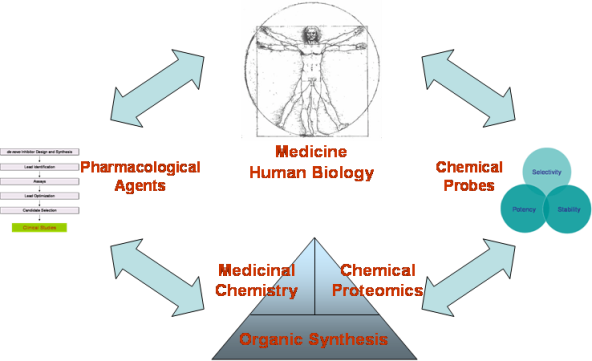
1) Tumor oriented medicinal chemistry
For many types of human tumor diseases, a large number of biological data prove that abnormal kinase activity is abnormally active in these diseases. Therefore, our medicinal chemistry direction focuses more on this kind of key drug targets. We are developing a variety of binding forms to target the kinase catalytic domain with and implement new compounds targeting other domains of the kinase.
2) Kinomics: a precise tool for signal transduction research
The activity of cells is greatly affected by biological and chemical signals. Kinases are major regulators of signal transduction pathways. Our main goal is to be able to detect kinase activity directly in the endogenous environment of human living cells. We are developing novel activity / affinity probe kinases and methods to capture the physiological substrates of these enzymes and understand the controlling factors of time and space in the cell loop.
3) Developing synthetic methodology
One of the many scientific research bases is organic synthesis. Despite the amazing progress in this field, there is still a great need to discover new methods to provide convenient clinically relevant bioactive molecules.
Representative Achievements
1) Ding, N.; Li, X.; Shi, Y.; Ping, L.; Wu, L.; Fu, K.; Feng, L.; Zheng, X.; Song, Y.*;Pan, Z. *; Zhu, J.* “Irreversible dual inhibitory mode: the novel Btk inhibitor PLS-123 demonstrates promising anti-tumor activity in human B-cell lymphoma.”Oncotarget2015, published online Apr 14.
2) Zhang Q, Liu H,Pan Z.*“A general approach for the development of fluorogenic probes suitable for no-wash imaging of kinases in live cells”Chem. Commun.2014,50, 15319.
3) Liu H, Yang Z,Pan Z.*“Synthesis of Highly Substituted Imidazolidine-2,4-dione (Hydantoin) through Tf2O-Mediated Dual Activation of Boc-Protected Dipeptidyl Compounds”Org. Lett.2014,16, 5902.
4) Zhou Y, Guo T, Tang G, Wu H, Wong N-K,Pan Z.*“Site-selective Protein Immobilization by Covalent Modification of GST Fusion Proteins”Bioconjugate Chem.2014,25, 1911.
5) Li X, Zuo Y, Tang G, Wang Y, Zhou Y, Wang X, Guo T, Xia M, Ding N,Pan Z.*“Discovery of a Series of 2,5-Diaminopyrimidine Covalent Irreversible Inhibitors of Bruton’s Tyrosine Kinase with in Vivo Antitumor Activity”J. Med. Chem.2014,57, 5112.
6) Zhou Y, Guo T, Li X, Dong Y, Galatsis P, Johnson D S,Pan Z.*“Discovery of selective 2,4-diaminopyrimidinebased photoaffinity probes for glyoxalase I”Med. Chem. Commun.2014,5, 352. (Invited for the thematic issue on “Chemical biology for target identification and validation”)
7) Zheng J, Lin S, Zhu X, Jiang B*, Yang Z*,Pan Z.*“Reductant-directed formation of PS-PAMAM-supported gold nanoparticles for use as highly active and recyclable catalysts for the aerobic oxidation of alcohols and the homocoupling of phenylboronic acids.”Chem. Commun.2012,48,6235.
8) Honigberg, L.A.; Smith, A.M.; Sirisawad, M.; Verner, E.; Loury, D.; Chang, B.; Li, S.;Pan, Z.;Thamm, D.H.; Miller, R.A.; Buggy, J.J. “The Bruton Tyrosine Kinase Inhibitor PCI-32765 Blocks B-cell Activation and Is Efficacious in Models of Autoimmune Disease and B-cell Malignancy”Proc. Natl. Acad. Sci. USA2010,107,13075.
9) Pan, Z.; Scheerens, H.; Li, S.-J.; Schultz, B. E.; Sprengeler, P. A.; Burrill, L. C.; Mendonca, R. V.; Sweeney, M. D.; Scott, K. C. K.; Grothaus, P. G.; Jeffery, D. A.; Spoerke, J. M.; Honigberg, L. A.; Peter R. Young, Dalrymple, S. A. and Palmer, J. T. “Discovery of Selective Irreversible Inhibitors for Bruton’s Tyrosine Kinase”ChemMedChem2007,15:58. (corresponding author)
10) Pan, Z.; Jeffery, D. A.; Chehade, K.; Beltman, J.; Clark, J. M.; Grothaus, P. G.; Bogyo, M. and Baruch, A. “Development of Activity-based Probes for Trypsin-family Serine Proteases”Bioorg. Med. Chem. Lett.2006,16: 2882. (co-corresponding author)