Educational Background
2014–2019: Ph.D in Integrated Life Sciences (Chemistry), Peking University
2008–2014: Bachelor & Master in Life Sciences (Accelerated Program, National Science Base Class), Northeast Agricultural University
Work Experience
2024–Present: Assistant Professor/Specially Appointed Researcher, School of Chemical Biology and Biotechnology, Peking University Shenzhen Graduate School
2019–2024: Postdoctoral Researcher, Ben May Cancer Research Institute, University of Chicago
Awards and Honors
2025: High-Level Overseas Talent, Guangdong Province
2025: Outstanding Youth Oral Presentation Award, 21st Analytical Testing Academic Conference
2018: Outstanding Poster Award, 10th Chinese Proteomics Conference
2018: National Scholarship, Peking University
2018: Meritorious Student Award, Peking University
2017: Outstanding Poster Award, 3rd National Mass Spectrometry Analysis Academic Conference, Chinese Chemical Society
Research Interests
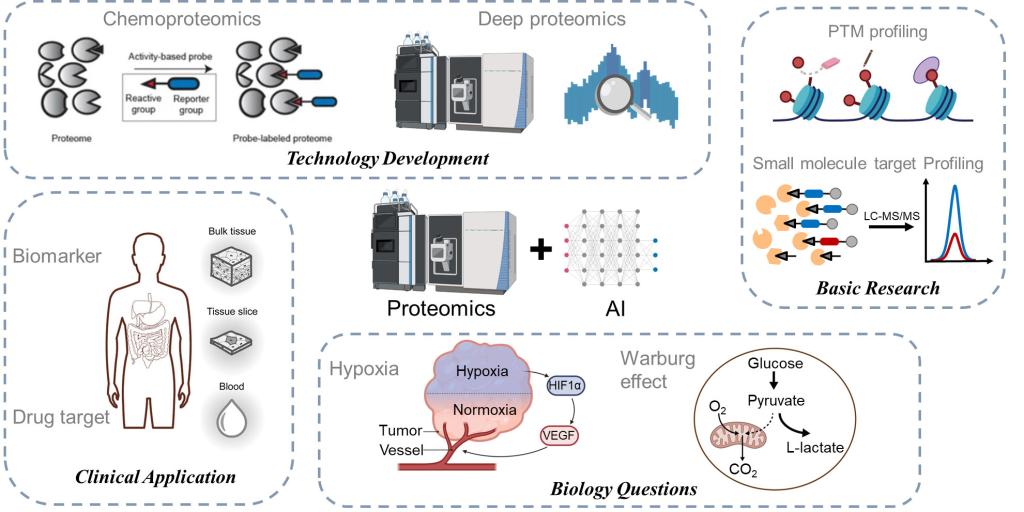
Our research group is dedicated to innovating artificial intelligence-driven proteomics methodologies and combining cutting-edge chemical and molecular biology tools to explore the functional mechanisms of post-translational modifications (PTMs) in cellular processes and disease pathogenesis. Our goal is to identify disease biomarkers and discover novel therapeutic targets and drugs. Specific research directions include:
1.Developing an AI-driven deep proteomics platform and utilizing it to discover novel PTMs.
2.Applying chemical proteomics approaches to study the regulatory mechanisms and functions of PTMs. Our current focus is primarily on lysine lactylation, aiming to elucidate its critical role in the development and progression of major diseases such as cancer and neurodegenerative disorders, and to develop targeted chemical interventions accordingly.
3.AI-based clinical proteomics research, in-depth exploration of disease biomarkers and drug targets, providing strong technical support for the advancement of precision medicine.
Representative Publications
Jinjun Gao, Ruilong Liu, Kevin Huang, Ziyuan Li, Xinlei Sheng, Kasturi Chakraborty, Chang Han, Di Zhang, Lev Becker, Yingming Zhao*. Dynamic investigation of hypoxia-induced lysine L-lactylation. Proc Natl Acad Sci U S A. 2025;122:e2404899122.
Di Zhang*#, Jinjun Gao#, Zhijun Zhu#, Qianying Mao, Zhiqiang Xu, Pankaj K Singh, Cornelius C. Rimayi, Carlos Moreno-Yruela, Shuling Xu, Gongyu Li, Yi-Cheng Sin, Yue Chen, Christian A. Olsen, Nathaniel W. Snyder, Lunzhi Dai*, Lingjun Li*, Yingming Zhao*. Lysine L-lactylation is the dominant lactylation isomer induced by glycolysis. Nature Chemical Biology 2025;21:91-99.
Jinjun Gao, Xinlei Sheng, Jianfeng Du, Di Zhang, Chang Han, Yue Chen, Chu Wang*, Yingming Zhao*. Identification of 113 new histone marks by CHiMA, a tailored database search strategy. Science Advances, 2023, 9, eadf141
Jinjun Gao#, Fan Yang#, Jinteng Che, Yu Han, Yankun Wang, Nan Chen, Daniel W. Bak, Shuchang Lai, Xiao Xie, Eranthie Weerapana, Chu Wang*. Selenium-Encoded Isotopic Signature Targeted Profiling. ACS Central Science 2018. 4:960-970. DOI: 10.1021/acscentsci.8b00112
Jinjun Gao#, Yuan Liu#, Fan Yang, Xuemin Chen, Benjamin F. Cravatt, Chu Wang*. CIMAGE2.0: An Expanded Tool for Quantitative Analysis of Activity-based Probe Profiling (ABPP) Data. Journal of Proteome Research. 2021. 10.1021/acs.jproteome.1c00455.
Fan Yang#, Jinjun Gao#, Jinteng Che, Guogeng Jia, Chu Wang*. A Dimethyl-Labeling-Based Strategy for Site-Specifically Quantitative Chemical Proteomics. Analytical Chemistry. 2018. 90:9576-9582. doi: 10.1021/acs.analchem.8b02426