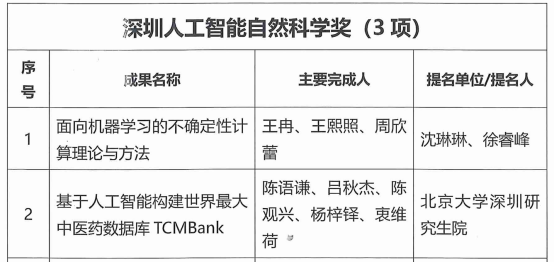
On March 21, 2025, the results of the 4th "Shenzhen Artificial Intelligence Award" for 2024 were announced. The research team led by Yuqian Chenfrom Peking University Shenzhen Graduate School was awarded the Shenzhen Artificial Intelligence Natural Science Award for their project "Constructing the World's Largest Traditional Chinese Medicine Database TCMBank Based on Artificial Intelligence." The award is presented by the Shenzhen Artificial Intelligence Society.
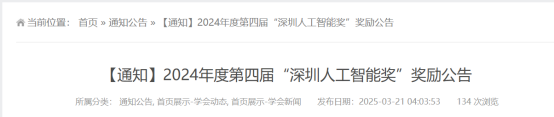
The selection process for this award was conducted in accordance with the Shenzhen Artificial Intelligence Society Award Regulations and the Implementation Rules for the Shenzhen Artificial Intelligence Society Awards. For the achievements nominated for the 4th "Shenzhen Artificial Intelligence Award" in 2024, the Shenzhen Artificial Intelligence Society carried out procedures including formal review, preliminary evaluation, expert discussion, and final review. Following a 7-day public notice on the Society's official website and WeChat public account, the award results were reviewed and approved by the Society's Award Committee, reported to the Chairman of the Shenzhen Artificial Intelligence Society for final approval. It was decided to grant the 2024 4th "Shenzhen Artificial Intelligence Award" Natural Science Award to three achievements. This award-winning project, "Constructing the World's Largest Traditional Chinese Medicine Database TCMBank Based on Artificial Intelligence," was nominated by Peking University Shenzhen Graduate School and completed by the team led by Dr. Chen Yuqian, Director of the AI4S Platform Center. The TCMBank database has a profound impact and has long become one of the most frequently used and highest-traffic websites for scholars conducting AI-based drug screening in the field of Traditional Chinese Medicine.
The TCMBank database integrates 9,192 herbs, 61,966 non-redundant components, 15,179 targets, 32,529 diseases, and their pairwise relationships, achieving for the first time a paradigm shift in TCM knowledge from "empirical inheritance" to "data-driven." The project overcame three major technical barriers:
1)Human-Machine Collaborative Annotation System: Developed an intelligent literature recognition module and an AI-assisted annotation platform, increasing annotation efficiency by 17 times compared to traditional methods.
2)Multi-source Heterogeneous Data Fusion Technology: Aligned terminology differences across historical medical texts using deep transfer learning algorithms, constructing a cross-modal unified semantic framework.
3)AI-Assisted Models: Revealed the active ingredients and mechanisms of action of complex TCM formulas, establishing new paradigms for lead compound design, drug-target identification, prediction of adverse drug reactions (both TCM and Western medicine), molecular retrosynthesis, and vaccine design.
This database not only addresses the challenge of fragmented TCM data but also pioneers a new paradigm of AI empowering traditional disciplines, promoting the modernization and personalized development of TCM.
Shenzhen Artificial Intelligence Natural Science Award
The Shenzhen Artificial Intelligence Natural Science Award is granted to individuals who have made significant scientific discoveries by elucidating natural phenomena, characteristics, and laws in basic and applied basic research within the field of intelligent science and technology. According to theShenzhen Artificial Intelligence Society Award Regulationsand related selection rules, the 2024 4th "Shenzhen Artificial Intelligence Award" underwent procedures including formal review, preliminary evaluation, public notice, and final review, resulting in the selection of3recipientsfor the 2024 Shenzhen Artificial Intelligence Natural Science Award.